

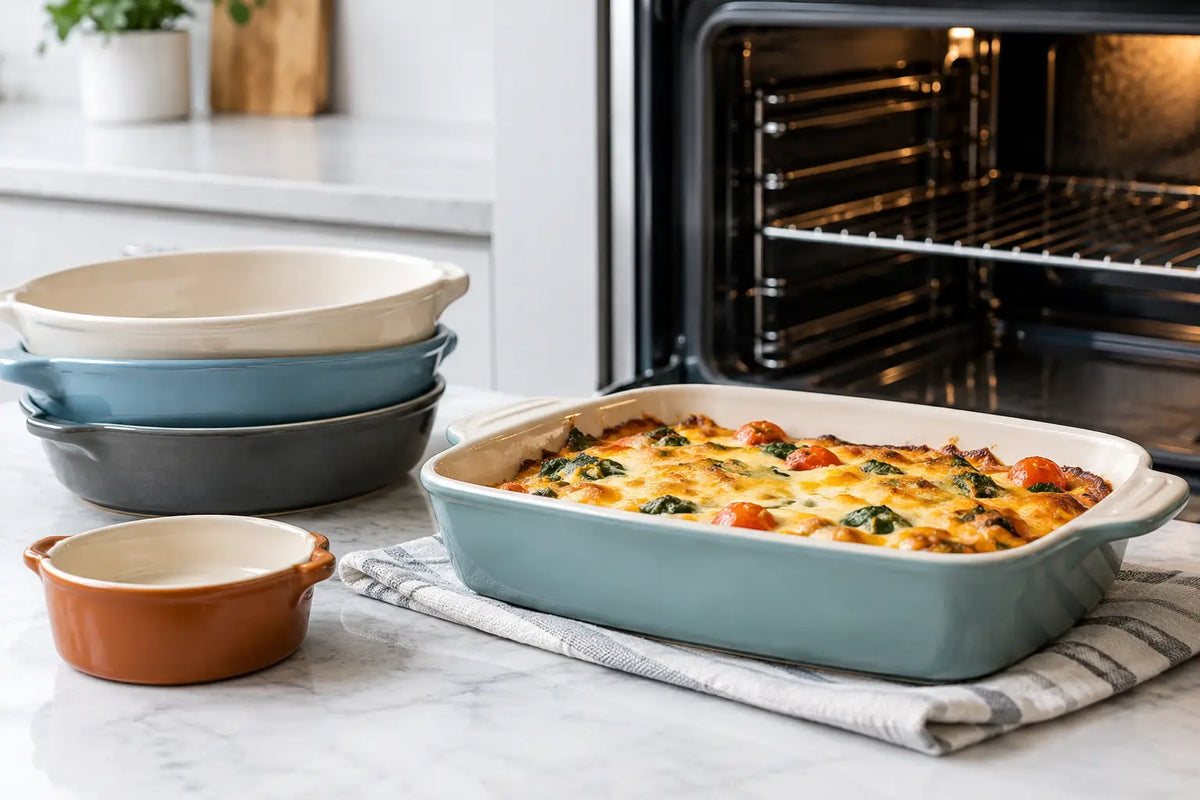
A bubbling fruit crisp looks far more inviting when it comes to the table in the same beautiful dish it baked in. But are ceramic dishes oven safe? Sometimes, yes - provided the piece is made and labeled for oven use. Ceramic is a broad category, and a plate that performs beautifully at dinner may not be built for the sudden, sustained heat of baking.
The safest answer is always on the product care instructions. If a ceramic dish is specifically marked oven safe, use it within the stated temperature limit. If there is no oven-safe marking, treat it as serving ware rather than bakeware, no matter how substantial or high-quality it feels.
Are Ceramic Dishes Oven Safe for Everyday Cooking?
Ceramic dishes can be oven safe because clay fired at high temperatures becomes hard, stable, and capable of retaining heat. Stoneware, porcelain, and certain ceramic casserole dishes are common choices for baked pastas, cobblers, roasted vegetables, and small gratins. Their warmth and weight also make them especially lovely for serving family-style meals.
Still, oven safety is not determined by material alone. The shape and thickness of the piece, its glaze, the firing process, and the manufacturer's testing all matter. A ceramic baking dish is engineered to tolerate cooking temperatures. A decorative bowl, dinner plate, or vintage serving platter may not be, even if each is technically ceramic.
For dependable everyday use, look for care guidance that clearly says "oven safe" and gives a maximum temperature. This is more meaningful than an assumption based on heft or appearance. Well-made, high-fired stoneware is often a practical choice for oven-to-table cooking, but it should still be used according to its individual care instructions.
Stoneware, porcelain, and bone china are not identical
Stoneware is often the most familiar ceramic option for baking and casual oven use. It is generally dense, durable, and made to hold heat well. Many stoneware bakers and mini casseroles are designed for direct oven service, making them useful when you want one piece to handle preparation, cooking, and presentation.
Porcelain is fired at very high temperatures and can also be durable, but its oven suitability varies by product. Porcelain dinnerware can be thin and refined, while porcelain bakeware may be made with a different purpose and construction. Check the manufacturer’s instructions rather than relying on the word porcelain alone.
Fine bone china is prized for its luminous finish and remarkable strength relative to its delicate profile. However, it is not automatically a baking material. Many fine bone china pieces are best reserved for serving food or gently warming when the maker explicitly permits it. A beautiful dinner plate deserves care, especially if it includes metallic trim.
Earthenware is usually more porous and less tolerant of heat changes than high-fired stoneware or porcelain. Unless it is labeled oven safe, it is better suited to the table than the oven.
The Biggest Risk Is Thermal Shock
Ceramic rarely fails because an oven is simply too hot. More often, cracks happen because the dish experiences a sharp change in temperature. This is called thermal shock.
Imagine taking a cold casserole dish from the refrigerator and placing it in a hot oven. The outside heats and expands before the center can catch up. That stress can create a crack, a chip, or, in severe cases, a complete break. The same problem can occur when a hot dish is set on a wet countertop, rinsed under cool water, or moved directly from the oven to a cold stone surface.
A few careful habits protect both your cookware and your meal. Let a refrigerated ceramic dish sit at room temperature briefly before heating it, unless its instructions say otherwise. Place hot ceramic on a dry towel, trivet, or wooden board. After baking, allow the dish to cool before washing it. Never add cold liquid to a hot ceramic pan.
Avoid using ceramic under the broiler unless it is expressly rated for broiler use. Broilers apply intense, concentrated top heat, which creates a different kind of stress than regular baking. The same caution applies to stovetops: most ceramic dinnerware and baking dishes are not designed for direct burner heat.
How to Tell Whether a Ceramic Dish Belongs in the Oven
Start with the underside of the dish and any original product information. A stamped symbol or written care note is the best first indicator. If the dish says oven safe, note the temperature limit and whether the instruction excludes broiling, microwaving, or rapid temperature changes.
If the label is missing, consider the dish’s original purpose. A deep casserole with sturdy handles is more likely to be made for baking than a flat dinner plate. Yet this is only a clue, not a guarantee. Older, inherited, handmade, or thrifted ceramics deserve extra caution because their glaze composition, firing history, and prior wear may be unknown.
Inspect the piece before every oven use. Hairline cracks, deep utensil marks, crazing that has worsened over time, or chips around the rim can weaken a dish. A small surface imperfection does not always mean immediate failure, but it is a good reason to retire the piece from high-heat cooking. Save it for dry serving, display, or a less demanding role.
Decorative details matter, too. Gold, silver, platinum, and other metallic accents should not go in the oven unless the manufacturer clearly says they can. Metallic decoration may discolor, crack, or become unsafe under heat.
A Safer Way to Bake and Serve in Ceramic
When you have confirmed that a dish is oven safe, using it thoughtfully is straightforward. Begin with a dry, room-temperature dish whenever possible. If your recipe allows, place the filled dish in a cool oven and let both heat gradually together. This approach can reduce temperature stress, although baking times may need a small adjustment.
Use oven mitts that give you a secure grip. Ceramic retains heat longer than metal, which is a benefit at the table but easy to forget once the dish has left the oven. Keep children and guests aware that a handsome serving dish may remain hot well after the food is served.
For recipes with very high heat, frequent broiling, or major temperature swings, metal or cast iron can be the better tool. Ceramic excels at even, gentle baking and polished oven-to-table presentation. Choosing the right material is not about treating one as better than another. It is about matching the piece to the way you cook.
What about reactive-glaze dinnerware?
Reactive glazes create the nuanced variation that makes each place setting feel distinctive. The glaze itself is not a universal promise of oven safety. What matters is the complete piece: its clay body, firing process, construction, and stated care guidance.
High-fired ceramic dinnerware can be wonderfully durable for daily meals, and lead- and cadmium-free standards are essential for food-contact safety. But food safety and oven safety are separate questions. A dish can be safe for serving hot food without being intended for baking. At HomeVss, that distinction supports a simple goal: choose beautiful tableware with confidence, then use each piece in the setting it was designed to handle.
When to Skip the Oven Entirely
Do not place a ceramic dish in the oven if it is cracked, has unknown care instructions, carries metallic decoration, or has just come from the freezer or refrigerator. Skip oven use if the dish has a non-ceramic attachment such as a plastic knob, glued-on handle, or decorative component that may not tolerate heat.
Also resist the temptation to test an unmarked dish with an empty high-heat bake. An empty ceramic piece can heat quickly and unevenly, and a home test cannot confirm whether the glaze or structure is suitable for repeated cooking. The cost of a broken dish, damaged oven, or wasted dinner is not worth the guesswork.
A ceramic dish made for the oven brings an easy kind of luxury to the meal: baked macaroni and cheese served in its golden casserole, or a warm berry crumble passed around after dinner. Give it gradual heat, a stable landing place, and the care instructions it deserves, and it can make ordinary evenings feel thoughtfully set.


Hinterlasse einen Kommentar
Diese Website ist durch hCaptcha geschützt und es gelten die allgemeinen Geschäftsbedingungen und Datenschutzbestimmungen von hCaptcha.